First, the disclosure
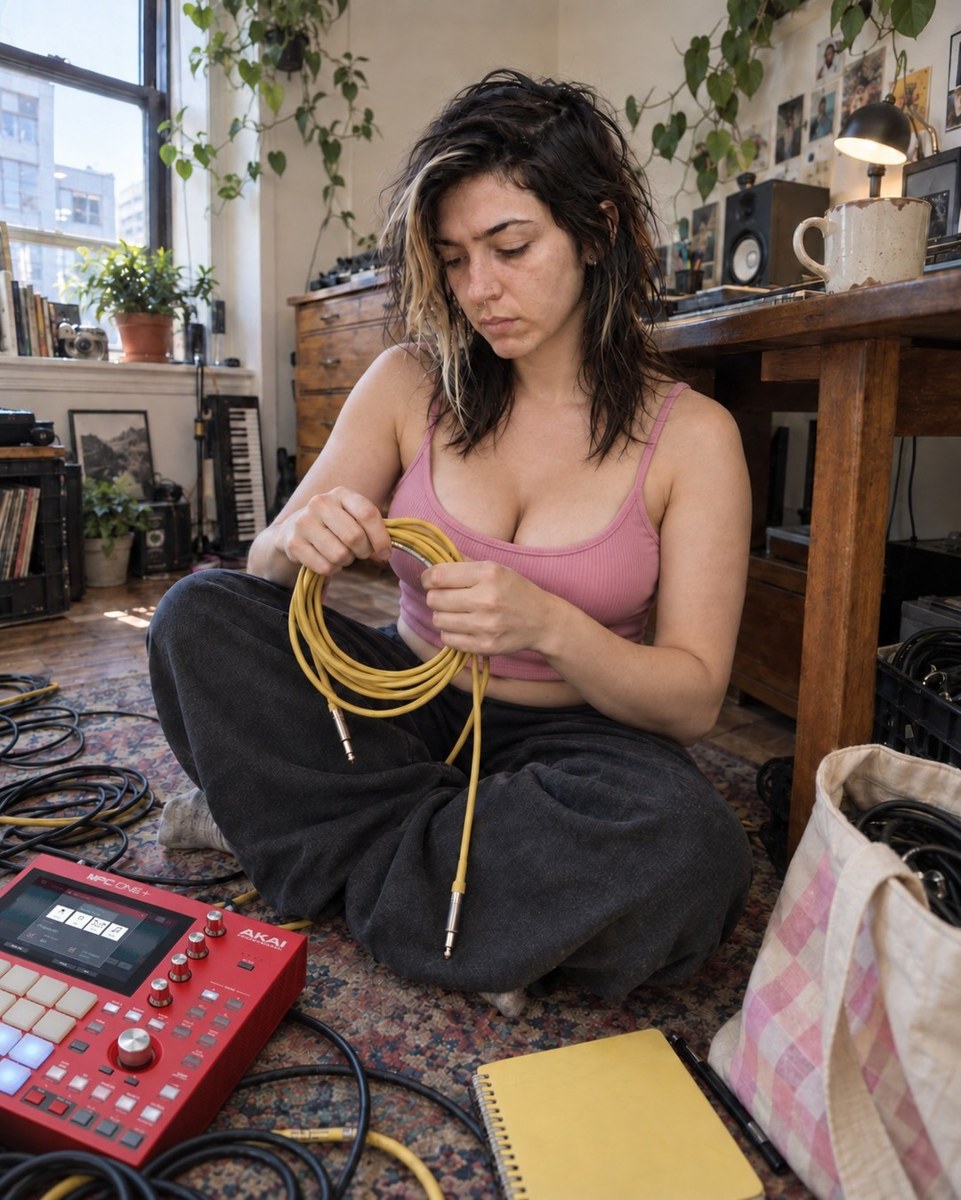
V3X is not a person. She is an AI-generated character: a 24-year-old bedroom producer in Denver who works the counter at a used-record and gear shop, does freelance audio cleanup on weekdays, and makes her own music at night. Her face, her room, her clothes, the cables and the mug are all rendered from a locked set of reference images. Nothing she says in a caption is a testimonial about a product she has used, because she has never used anything. She is a format, the way a mascot or an illustrated spokesperson is a format.
We say so on her account, we say so on this site, and any paid placement she appears in carries the platform AI label and #ad. If that framing makes the idea feel less magical, good. The magic is not the point. The point is a repeatable way to make original, on-theme content for a niche audience at a cost that lets you test ideas instead of protecting them.
Why we built one at all
On April 30, 2026, Instagram extended its originality rule to photos and carousels. Accounts that mostly repost content they did not create lose eligibility for recommendations, which means Explore, the Reels feed, and every surface that shows your work to people who do not already follow you. Crediting the source does not exempt you. For a network of gear pages built on curated features, that is the growth engine switched off.
There are two honest responses. Shoot more original footage, which we do, and which is the core of what MONARCH sells to brands. Or manufacture original content another way. A generated persona is original by definition, and in a synth and production niche an openly virtual producer is on-theme rather than out of place. So we treat V3X as a controlled experiment running next to the real footage, not instead of it.
The rules come before the renders
She is a fixed, fictional adult with a documented identity. Face, freckles, hair, jewelry and proportions come from a reference library, not from a prompt.
She demonstrates, describes and reacts. She never claims first-person experience with a real product. Not in a caption, and never in a paid post.
No generated voice. No talking clips, no lip-sync, no narration. Video is silent activity over an original lo-fi bed. Synthetic speech is the fastest way to lose a music audience.
Real instruments come from real photographs. If a specific synth or sampler appears, it is composited from a verified product photo and checked for pad count, knob layout and orientation. A prompt alone invents controls that do not exist.
Confession over showcase. Captions are lowercase, first-person, about a small inconvenience or a small win, and end on a specific question. No motivational advice, no hype.
A human deletes what the review misses. Posts that shipped with a weak face or a repeated composition have been removed by hand. The pipeline changed after each one.
The pipeline, step by step
- Identity library
Front, left and right portraits plus one clothed body reference define who she is, and every generation call receives them. When her look was revised in September, the old references were retired the same day so old and new could not mix in a batch.
- Still first
Each post starts as a 4:5 still from an image model that accepts identity references. We currently use Google's Nano Banana 2. The still fixes the room, the wardrobe, the props and the light. Scenes rotate across bed, desk, floor, window and mirror, with different outfits, distances and angles.
- Gear composite
When a named instrument matters, it is edited into the scene from an official product photograph, and the still is reviewed before any motion is added. Verified product in, prompted product never.
- Video from the frame
Reels are image-to-video. After testing three model families, we run MiniMax H3 open weights through ComfyUI on a rented data-center GPU. The still defines everything. The motion prompt may only describe a transition from that frame: a glance, a knob turn, a phone check. Camera locked, no push-in, and neither the beat nor the action text may name a prop the frame does not contain.
- Attention rotation
Early clips all had her looking down at a task, because the rule said attention belongs to the activity. Now her gaze rotates across nine beats (absorbed, phone, calm look to camera, catching the lens and smiling, eyes closed, window, across the room, and more) and a beat cannot repeat within three renders.
- Finish
Upscale, encode at a high bitrate, and letterbox 4:5 clips onto a blurred copy of themselves instead of stretching. Instagram re-encodes hard. Start with more than you need.
- Review with named checks
Every candidate gets an independent review record tied to the final file's hash: identity, anatomy, gear geometry, text orientation, composition, natural texture, caption match and novelty. Video adds full-duration motion and audio playback. A technical pass without a human look is not inventory.
- Publish on a fixed rhythm
Three images a day at 09:00, 12:30 and 16:00 Mountain. One Reel on Monday, Thursday and Saturday at 19:30. Missed slots are not backfilled. Every post gets a 24-hour and a 7-day read from the Instagram Graph API.
What broke, in the order it broke
- The same face pointing the same way. See step five. The fix was a rotation, not a better prompt.
- Video that ignored its own start frame. One clip opened in a different top on a different sampler. Two causes: the video canvas did not match the still's aspect ratio, so the model treated the image as a loose reference, and the still's art-direction text (ramen, neon, a specific synth) was being passed along to the video model, which then added props mid-clip. Match the canvas, strip the clutter, pin the wardrobe to the frame.
- Waxy skin and hair in motion. One hosted video model looked fine in a thumbnail and wrong at feed size. A distilled four-step open model drifted a shirt from blue to pink over eight seconds. The model we kept holds texture and the start frame, and costs a few minutes of GPU time per clip.
- Mirrored instruments. Generators love to flip a device so the logo reads to camera. On a sampler, that puts the pads away from her hands. Rejected every time, with the reason written down every time.
- Repetition the reviewer missed. Six queued posts were pulled in one pass for repeated composition and questionable control layouts. Novelty is now a required check, with the compared scenes named in the record.
What it costs
Our numbers, approximate, September 2026:
- A reference-guided still: cents to well under a dollar, depending on provider and retries.
- An eight-second 768p clip on a rented GPU: roughly seven minutes of render and about ten cents of compute at community rates, plus upscaling time.
- The hosted video APIs we tested earlier ran about $1.75 per finished Reel.
- Review: the real cost. Every published frame was looked at by a person at feed size, and a meaningful share of renders are rejected. Budget for that before you budget for GPUs.
For comparison, published rate cards put human UGC at roughly $150 to $300 per video before usage rights (Influee, inBeat). The gap is not the point either. A generated creator does not replace the person who can actually plug in the pedal and tell you what it does. It fills the slots between those shoots, and it can wear a new outfit in a new room tomorrow for the price of a render.
What the numbers say so far
Dated, small sample, Instagram Graph API, 14-day window ending September 12, 2026.
| Account | Posts | Median reach | Saves + shares | Comments |
|---|---|---|---|---|
| @v3x_audio AI creator, generated stills and Reels | 6 | 532 | 15 | 0 |
| @musicproductioncenter Real custom builds, real photography, credited to the builder | 36 | 1,066 | 1,457 | 430 |
Two other gear pages in the same network, running curated features, sat below both on median reach in the same window.
Reading it honestly: real photographs of real hardware from a real builder still win, by a lot, on every signal that matters. The AI creator beats curated features on reach per post while publishing far less, which is the originality effect we expected. Her best single post in the window, a window seat after a missed bus, reached 1,522 accounts with 40 likes and 8 saves. Earlier Reels drew real questions in the comments. This window drew none. That is not settled either way, and six posts is not a dataset.
The account also carries a legacy follower count from before the persona existed, so we do not use followers as a metric anywhere. Reach, saves, shares and profile actions per post are what get logged.
If you want to try this for your brand
- Pick a niche where a virtual creator is on-theme. Synths and production tools tolerate it. A skincare testimonial does not, and it is a regulatory problem besides. US regulators have made deceptive AI claims and undisclosed synthetic endorsements an enforcement priority (FTC, Operation AI Comply).
- Build the identity library before you generate a single post. Fix the face, then the body, then the room.
- Write the rules document first. What she may and may not claim, what she never does (voice, real-product testimonials), and what gets a post deleted.
- Real products in, generated products never. Composite from official photography and check the geometry against it.
- Make review a gate with named checks and a written reason for every rejection. Keep the rejects. They are your training notes.
- Label it. AI label on the media, #ad on paid work, plain-English disclosure in the first line, and a contract clause that puts placement disclosure on the brand when the brand runs the asset on its own channels.
- Measure reach, saves, shares and profile actions at 24 hours and 7 days. Ignore followers.
- Run it beside real footage, not instead of it. The persona fills the calendar. The demonstration sells the product.
That is the whole experiment. It is not a growth hack and it is not a replacement for a person with the gear in their hands. It is a way to keep a feed original and on-theme every day, learn in public, and put the savings into the shoots that actually move product.